His Crohn's was fine. His iron wasn't. Here's what we missed.
# His Crohn's Was Fine. His Iron Wasn't. Here's What We Missed.
If your iron keeps dropping while your gastroenterologist tells you your Crohn's is under control — you're not imagining things, and neither result is wrong. Iron deficiency in Crohn's disease can persist even in remission, because the mechanisms that deplete iron are separate from the ones that show up on a colonoscopy. The short answer: low iron and quiet Crohn's can — and frequently do — exist at the same time.
Now let me tell you how I learned this the hard way, as both a naturopath and a mum.
---
## Why My Son's "Normal" Results Weren't the Full Picture
My son's scope was clear. His gastroenterologist was satisfied. And still, he was sleeping three hours after school, struggling to concentrate, losing enthusiasm for sport he'd loved since he was small.
I kept thinking: this is the remission we worked so hard for — why does he still feel like this?
As a naturopath, I knew to ask for ferritin specifically. Not just haemoglobin. Not just a general blood count. Ferritin — the stored form of iron — is the earliest marker to drop, often long before haemoglobin shifts at all. His ferritin was sitting at the very bottom of the reference range. Technically "normal." Functionally depleted.
We addressed it. Slowly, carefully, with forms of iron his gut could tolerate. And over the following months, the boy who used to fall asleep on the couch at 4pm started staying up for dinner again.

---
## Why Iron Deficiency Happens Even When Crohn's Is "Under Control"
This is the part that surprises most families — and honestly, it surprised me too when I first started connecting the dots clinically.
Iron deficiency in Crohn's disease has multiple overlapping causes, and inflammation is only one of them. According to the Crohn's & Colitis Foundation, iron deficiency anaemia is the most common systemic complication of IBD — affecting up to 90% of patients at some point. But here's what that statistic doesn't tell you: it can be present even when disease activity is low.
Here's why:
1. Absorption is impaired in the small intestine. If your (or your child's) Crohn's has ever affected the duodenum or proximal jejunum — the primary sites where iron is absorbed — that absorption capacity may be reduced long-term, even after inflammation resolves. The gut tissue heals, but absorption efficiency doesn't always fully restore.
2. Hepcidin stays elevated longer than inflammation does. Hepcidin is the hormone that regulates iron storage and release. During and after inflammation, hepcidin levels remain elevated, effectively locking iron inside storage cells and preventing it from entering circulation. Your body has iron — it just can't access it properly. This is called functional iron deficiency, and it won't show up on a standard haemoglobin test.
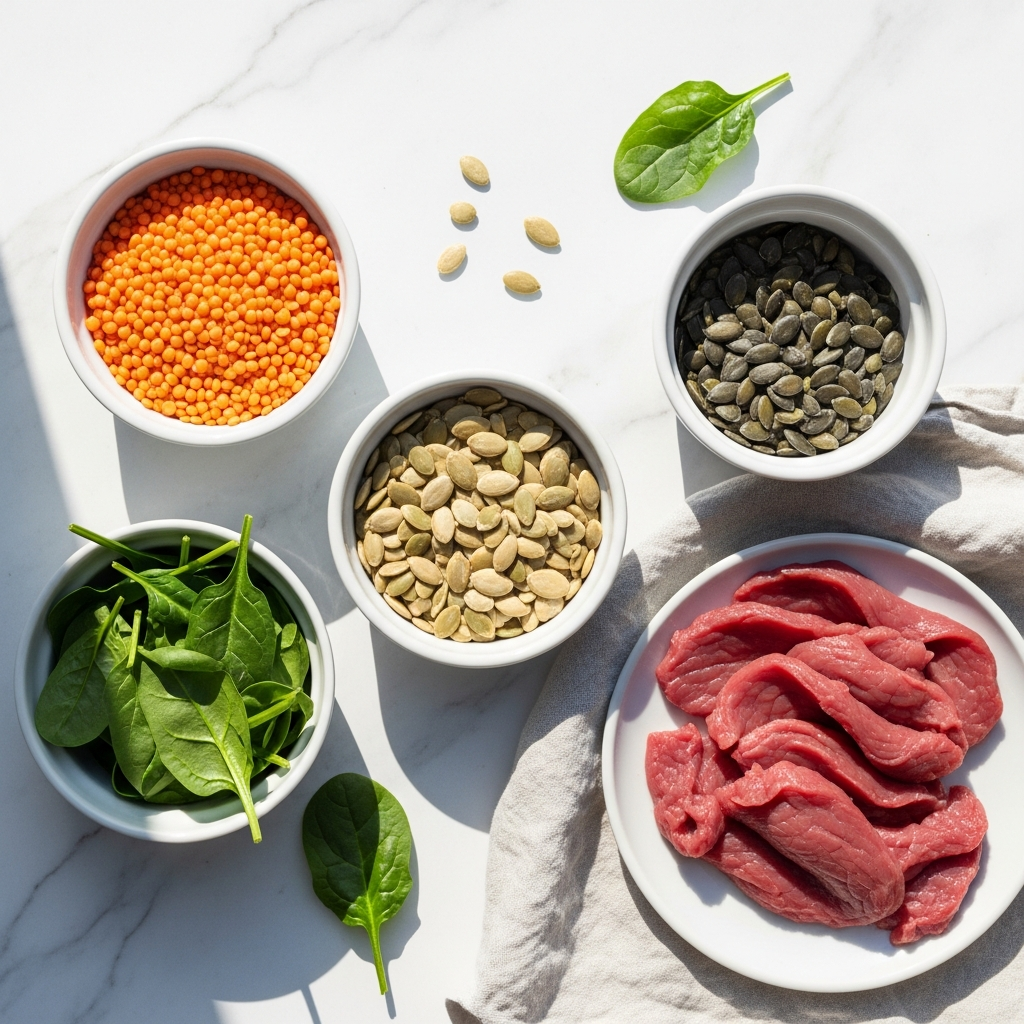
3. Dietary restriction compounds the problem. Many people with Crohn's — especially during recovery or cautious remission — restrict their diet significantly. Red meat, legumes, dark leafy greens: all common omissions. The Mayo Clinic notes that dietary iron intake is a key modifiable factor in managing deficiency. When the gut is already absorbing less, eating less iron creates a compounding deficit.
4. Chronic low-grade blood loss. Even in apparent remission, microscopic bleeding can occur at a level that doesn't show on a scope but accumulates over months. This is one reason fecal calprotectin — which I advocate testing from age 10 in children with family history — is so valuable. It catches what scopes sometimes don't.
Key takeaway: Iron deficiency in Crohn's is not a sign that your GI is wrong about remission. It's a sign that iron status needs its own dedicated monitoring, separate from disease activity markers.

---
## The Tests That Actually Tell You What's Happening
This is where I see the biggest gap in standard care — not because gastroenterologists are doing anything wrong, but because iron status and disease activity are often monitored separately, by different practitioners, with different panels.
If you're concerned about iron, here's what to ask for — and what each marker actually tells you:
- Ferritin — your iron storage. This is the first to drop and the most sensitive early marker. The NHS recommends ferritin as a first-line test for iron deficiency. "Normal" ranges vary widely by lab; for someone with Crohn's, many integrative clinicians aim for ferritin above 50 µg/L for optimal function, not just above the lab minimum.
- Serum iron — the iron currently circulating in your blood. Can fluctuate significantly day to day.
- Transferrin saturation — the percentage of iron-binding sites that are actually filled. Below 20% is often considered functionally low, even if serum iron looks acceptable.
- Full blood count (FBC/CBC) — haemoglobin, MCV, MCH. These reflect anaemia — the later stage. If you're waiting for haemoglobin to drop before investigating iron, you're catching it late.
As a naturopath working alongside medical care, I always look at the full picture together — not any single number in isolation.
---
## What to Do With This Information
If you or your child has Crohn's and is experiencing persistent fatigue, brain fog, poor exercise tolerance, or low mood — even in remission — please bring this to your gastroenterologist or GP and ask specifically for ferritin, serum iron, and transferrin saturation.
This is not about second-guessing your medical team. It's about adding a layer of monitoring that often falls through the cracks between specialists.
From a naturopathic perspective, supporting iron levels in Crohn's requires careful attention to the form of iron (some are far better tolerated than others by an inflamed gut), the timing of supplementation (away from calcium, tea, and coffee), and dietary changes that are realistic given the food fears many Crohn's patients carry.
I'll be covering all of that in detail in an upcoming post. But the first step is simply knowing to ask for the right tests.
---
## Common Questions
Can iron be low even if my Crohn's colonoscopy was clear?
Yes. A clear colonoscopy reflects mucosal healing, not iron status. Iron deficiency has separate causes in Crohn's — including impaired absorption, elevated hepcidin, and dietary restriction — that persist independently of visible inflammation.
What's the difference between iron deficiency and iron deficiency anaemia?
Iron deficiency means your stores are depleted. Anaemia means your haemoglobin has dropped as a result. You can have significant iron deficiency — with real symptoms like fatigue and brain fog — before anaemia develops. Ferritin catches deficiency earlier.
Should I just start taking iron supplements?
Not without testing first, and not without guidance from your healthcare team. Iron supplementation in Crohn's needs to be matched to your current inflammation status, your ferritin level, and your gut's tolerance. Some forms of iron worsen GI symptoms significantly. This supports, never replaces, a conversation with your gastroenterologist or GP.
How often should iron be monitored in Crohn's?
The European Crohn's and Colitis Organisation (ECCO) recommends monitoring iron status every 6-12 months in IBD patients, or more frequently if deficiency has been identified. If your iron isn't being checked regularly, it's worth asking why.
---
You're not imagining the exhaustion. And you're not failing at managing Crohn's. Sometimes the body is asking for something very specific — and it just needs someone to look for it.
— Kate
The Crohn's Method
Naturopath | Crohn's Mum | Family Navigator
This article is for informational purposes only and does not constitute medical advice. Always work with your gastroenterologist and healthcare team.